Strategies to Save Money on Taxes in Retirement

This post was last updated on February 27, 2026, to reflect all updated information and best serve your needs.
Are you looking for ways to avoid taxes on retirement and Social Security income? There are many retirement tax strategies you should be aware of. You may even be looking for how to avoid taxes on withdrawals from your 401k or other investment accounts.
It’s tempting to look for an IRS loophole to reduce taxable income in retirement. We’re not going to talk about hacks or questionable loopholes, but we'll outline some legal and proven methods to reduce your taxes in retirement.
Table of Contents
General overview
As mentioned, we want to explore all honest and prudent methods to reduce taxes. The IRS has plenty of ways you can reduce your tax burden in retirement. Unfortunately, the IRS (to be fair, Congress) seems to write the tax code to be as confusing and lengthy as possible.
Hopefully, we can explain some key strategies for you to use without making you dizzy or reach for the dictionary. We want to pay every cent we’re obligated to – but that’s it. You don’t get special treatment for tipping Uncle Sam.
Need help navigating your retirement income options? Get your free retirement income plan today!
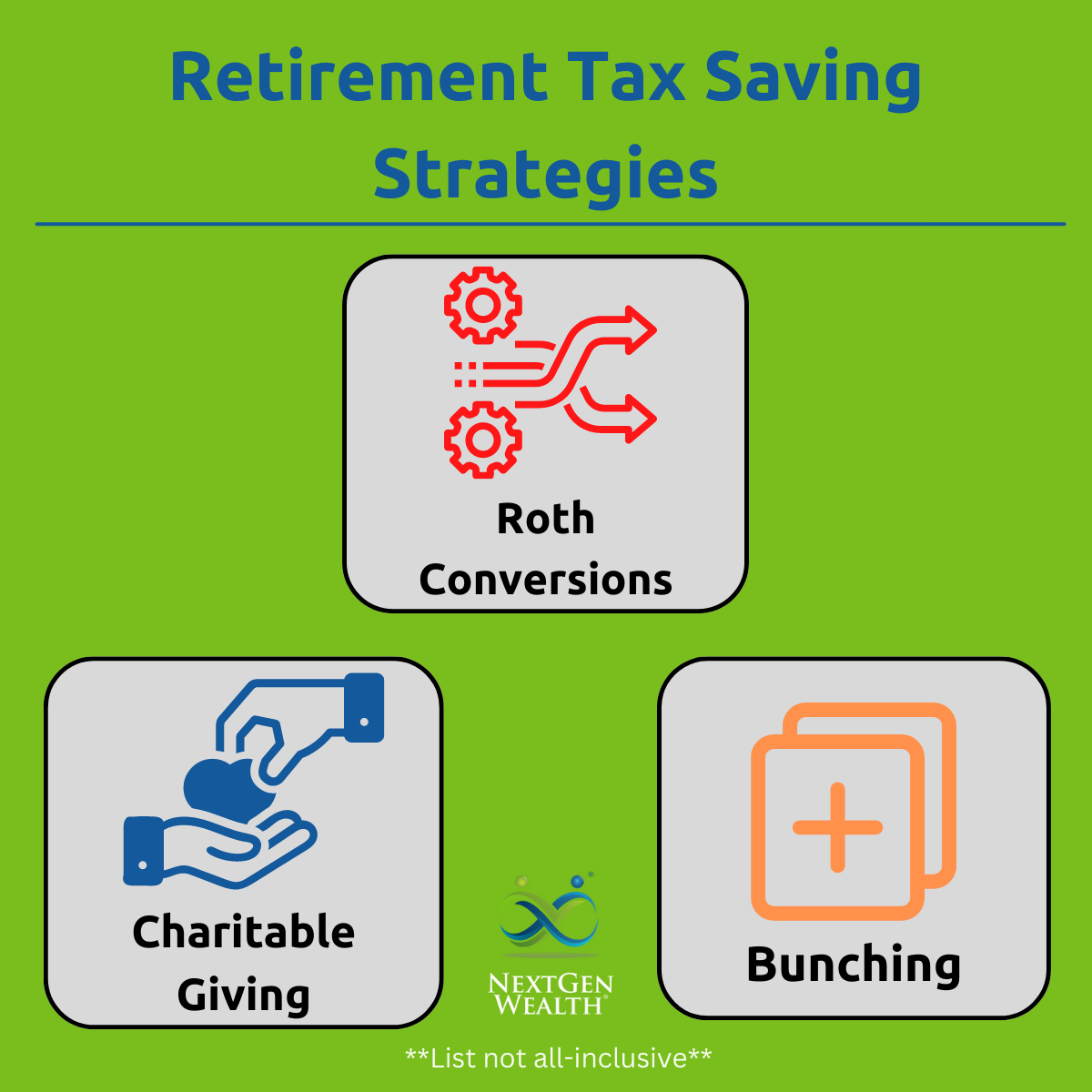
Roth Conversions
Roth conversions are arguably the most powerful and common tax-reduction strategy in retirement. We’ve written plenty about backdoor Roth conversions and even mega Roth conversions. Depending on how your retirement savings are held, a properly executed Roth conversion strategy could make a difference of $1 Million or more!
The basic strategy involves transferring, or “converting,” traditional retirement accounts (401k, 403b, IRA, etc.) into a Roth IRA. The drawback of the transfer is paying taxes at the time of the transfer. In other words, you’ll be “frontloading” your tax payments now so you can have tax-free withdrawals later.
Roth conversions can save you on taxes because Roth IRAs and other Roth accounts aren’t subject to required minimum distributions (RMDs), with the exception of inherited accounts. Instead of being forced to take money out of your retirement accounts when you might not need the funds, you can let your money grow tax-free. This helps you control the amount of income subject to higher tax brackets and keeps you under other thresholds, such as Medicare surcharges.
Bunching Deductions
Taking a hard look at your credits and deductions (with your accountant) could show some opportunities. If you don’t itemize deductions, it’s a good idea to look at what deductions you would qualify for and whether it still makes sense to take the standard deduction versus itemized deductions. Another thing to consider is whether you can incur these deductions (expenses) for a couple of years’ worth all at once – bunching deductions.
The basic strategy is to “bunch up” expenses in one year, claim the higher amount of itemized deductions, and then take the standard deduction in other years. This can take many forms, but the most common large deductible expenses may be medical expenses and charitable giving.
Bunching Medical Expenses
If you and your spouse can coordinate large out-of-pocket medical expenses in the same year, this could save you on taxes. Of course, this is only after prioritizing your health first. If you’ve been putting off a knee replacement (because surgery sucks!) or other important procedure, don't wait. If you happened to have a lot of medical expenses for the year, it might be a win-win to get yourself patched up while also saving on taxes.
Bunching Charitable Giving to Save On Taxes
You can also use a bunching strategy for charitable giving. If you already give to charity, then you can double up every other year and take advantage of bunching those contributions. You could also do this by donating through a Donor Advised Fund (DAF) over time.
Any deductible expense you can plan out ahead of time or prepay in some way could be bunched to take full advantage of the deductions provided to you in the tax code. You may find that expenses late in the year could be bunched into the next year with just a small change in timing.
Need help navigating your retirement income options? Get your free retirement income plan today!
Charitable Contributions
As we mentioned, there are many benefits to charitable giving. If charitable giving is part of your plan, you need to be aware of the tax benefits it offers. The IRS gives you a tax deduction for charitable giving because it’s something the government wants people to do.
You shouldn’t feel guilty about getting a tax deduction for charitable giving. Look at it this way: the more tax-efficient you are with your giving, the more you can do for charity with your hard-earned money. It’s not about you or the IRS; it’s about getting more dollars to causes you care about.
Qualified Charitable Deductions
Not all charitable giving is considered “qualified” for tax purposes. The IRS has a tool to help you find out if a charity is qualified or not. Most organizations will have their status as a charity listed on their website.
Limitations on Giving to Charity
You might be thinking you could bunch your charitable giving and wipe out most or all of your tax burden for the year – not so fast. There are limitations to how much you can deduct. You can still give all you want, but you may not be able to deduct it all.
You are typically limited to either 60%, 50%, 30%, or 20% of your adjusted gross income (AGI) for the year. We weren’t kidding about the tax code being complicated. Working with your accountant or tax preparer (CPA or EA) is a good idea.
Social Security Tax Savings
Saving money on taxes by coordinating with your Social Security withdrawal strategy is often overlooked. You might already be aware of (and be over) the thresholds for when portions of your Social Security are taxed. It might not be as easy to see when your total income from all retirement income sources will push you over those thresholds.
The thresholds for when your Social Security payments are taxed are somewhat low compared to other important thresholds. For joint filers, income between $32,000 and $44,000 (between $25,000 and $34,000 filing single), up to 50% of your Social Security benefits are taxed. More than $44,000 ($34,000 if filing single), up to 85% of your Social Security benefits are taxed.
Adding in Nontaxable Interest
The calculation for this threshold is a little more involved. It’s calculated by adding your Adjusted Gross Income, nontaxable interest (think government/municipal bonds), and 50% of your Social Security payments. This makes some of the strategies we’ve been talking about even more important – especially if you’re forced to take RMDs.
Income Related Monthly Adjustment Amounts (IRMAA)
Additional Medicare costs, such as IRMAA surcharges, can be really frustrating. It only takes going over thresholds by a single penny to raise your Medicare premiums for the entire year. Pay close attention to your modified adjusted gross income (MAGI) for Medicare premiums.
While IRMAAs are not technically a tax, they put a burden on your monthly budget the same way taxes do. You’ll see the difference every month as you pay the higher monthly premiums. It’s best to keep “Aunt IRMAA” away if possible.
Need help navigating your retirement income options? Get your free retirement income plan today!
Don’t Let Tax Savings Control Your Life
Although controlling your tax burden is important, we don’t want you to dwell on trying to avoid taxes. They say there are only two things certain in life – death and taxes. However, worrying too much about either one will make life a bit less fun.
How NextGen Wealth Can Help
NextGen Wealth believes your hopes, dreams, and overall well-being are what’s most important. We work with clients like you to manage all the dizzying details, so you don’t have to. Long-term planning is far superior to one-time "hacks" or sneaky “loopholes” here and there. Making well-informed choices about taxes before and throughout retirement will help you enjoy the retirement you’ve worked so hard to achieve.
If you'd like to see what working with NextGen Wealth looks like, contact us today to schedule your no-obligation financial assessment.

 This article was written by