

Check out our Ultimate Health Savings Account Guide Infographic. We think it's pretty awesome and sums up the true power of an HSA. For more information, check out our Ultimate Guide to Health Savings Accounts.
Check out our Ultimate Health Savings Account Guide Infographic. We think it's pretty awesome and sums up the true power of an HSA. For more information, check out our Ultimate Guide to Health Savings Accounts.

Are you familiar with a Health Savings Account (HSA)? If you’re like most people, you’ve heard the term but you’re probably not sure what it is or if it makes sense for you.
If that’s the case, then it’s your lucky day because we’re going to dig into exactly what a Health Savings Account is and, most importantly, why I absolutely love them. So with that, let’s check out a few statistics that just might surprise you.

This post was last updated on January 15, 2021, to reflect all updated information and best serve your needs.
When entering the job market out of college, the concept of retirement seems like a lifetime away. Most people can't even fathom thinking about retirement which leaves neglected and unleveraged retirement accounts.
This post was last updated on January 15, 2021, to reflect all updated information and best serve your needs.
Congratulations! You’ve worked for decades to prepare for retirement and now you’re there, or almost there, ready to start what can be the most enjoyable phase of your life. Very likely, you’ve got plans to travel, see family and friends and maybe even revisit hobbies you’ve neglected for decades.

Do you have a 529 plan? Do you work with a financial advisor? Do you have a 529 plan that’s managed directly through your financial advisor?
If you answered yes to the first question, then that’s perfectly fine. If you answered yes to the second question, that’s great as well. However, if you answered yes to the third question, well, that’s where I tend to differ from a lot of financial advisors… and yes, that’s coming from a financial advisor.

Did you know that real estate has produced more wealth than any other industry in the history of time? Retail real estate alone has produced an average annual return of 10.8% over the past two decades, according to data from the National Council of Real Estate Investment Fiduciaries Index.
However, as with any other business, property investing isn’t without its pitfalls. If not wisely planned, the cost of the property investment can quickly override the profits.

In today’s day and age of the internet, you can find just about anything in no time. Looking for a restaurant nearby? Go to the internet. Need a place to get a haircut? Go to the internet. Looking for background information on a financial advisor? Yep, go to the internet.
It amazes me how we found things before we had the internet. I guess we just asked for referrals from our friends, looked things up in the phone book or drove around until we found out what we were looking for…the indignity.

So, how many different companies have been at in your working career? If you’re like most people today, you’ve probably switched jobs at least a couple times. It seems like some people can switch every six months while others can stay for years.
Regardless, it’s extremely rare to see someone who stays with the same employer for life. Things have certainly changed from the baby boomer generation.

This post was last updated on January 15, 2021, to reflect all updated information and best serve your needs.
For many of us, our 401(k) or similar employer-sponsored retirement plan is our primary vehicle for retirement savings. A 401(k) is a defined contribution plan meaning that our retirement benefit is determined primarily by the amount that we save and how we invest those savings. However, there is a maximum 401k contribution limit that we will cover.

Now that the holidays are over, it’s back to reality. For many – hopefully, not you – it means paying off all the debts you racked up from your extremely generous giving. Let’s just hope you had already budgeted for it and you were merely using your credit card to get the free rewards.
Regardless of whether you have debt or not, sometimes, unknowns pop up in our lives where we need to get access to money. If you don’t have it sitting in a savings account – which I’m sure you do if you’re an avid reader of this blog – you have to find it somewhere.

Let’s face it; saving for your children’s college is quite the challenge. However, just as challenging is actually finding the right spot to send them off to college. There are so many choices with only so much money you can realistically spend without you and your child completely being indebted for the rest of your lives.
Sounds like a real pleasant experience, doesn’t it? Well, for most parents, it can really be a gigantic pain to find the right college for their children. Today, though, I’m going to explain how to make it a much more comfortable experience where everyone will understand and be happy.

With the Equifax date breach being announced just over a month ago, credit reports and credit scores were actually an important topic of conversation for a change. However, a month in this day and age can seem like years ago.
Now that it is almost considered old news, we’re back to our normal everyday lives and, believe it or not, that’s not thinking about our credit reports or even our credit scores. That has become old news and we’ve now moved on to the next headline.

Once we graduate college and get our first job, it seems like our next unwritten goal in life is to buy a new home. Right or wrong, that seems to be how life goes. I’m by no means saying it’s the wrong choice to make – heck I did it and still own a home – but should it really still be called the “American Dream?”
In my humble and probably subjective opinion, the answer is no. While home ownership can be an incredible feeling and certainly a feeling of “growing up,” it’s definitely not for everyone. There are plenty of pros and cons to owning a home just as there are plenty of pros and cons to renting. It’s up to each individual to determine what’s right for them.

This has to be one of the most common questions I get asked on a daily basis. It doesn’t matter who I’m talking to, inevitably the question comes up. However, if you know me as a financial planner, I am by no means a market prognosticator nor do I profess to be some kind of stock market guru.
Nonetheless, managing my client’s investments is part of my job, so I expect to have these types of questions. Now, whether I answer it in a black and white way is yet to be determined. On the one hand, the stock market has always gone up looking at it long-term, however, over the short-term, the market experiences all kinds of ups and downs.

Like it seems for just about every service profession today if you want to go the DIY route and figure it out for yourself, just Google it and you’ll be on your way. I swear I think there is a YouTube video for just about every DIY project you’re attempting to do around the house, with some being easier than others.
While it’s not quite that easy when it comes to managing your finances or becoming your own financial advisor, it can still be done. As long as you have the time and willingness to learn, you certainly can go at it yourself. Many people handle their personal finances themselves and do a great job.

Remember when saving for retirement used to be so easy? Yea, I don’t either because I wasn’t alive back then. However, if you were, all you had to do was work 40 years at your employer, get your pension and social security and then sail off into the retirement sunset.
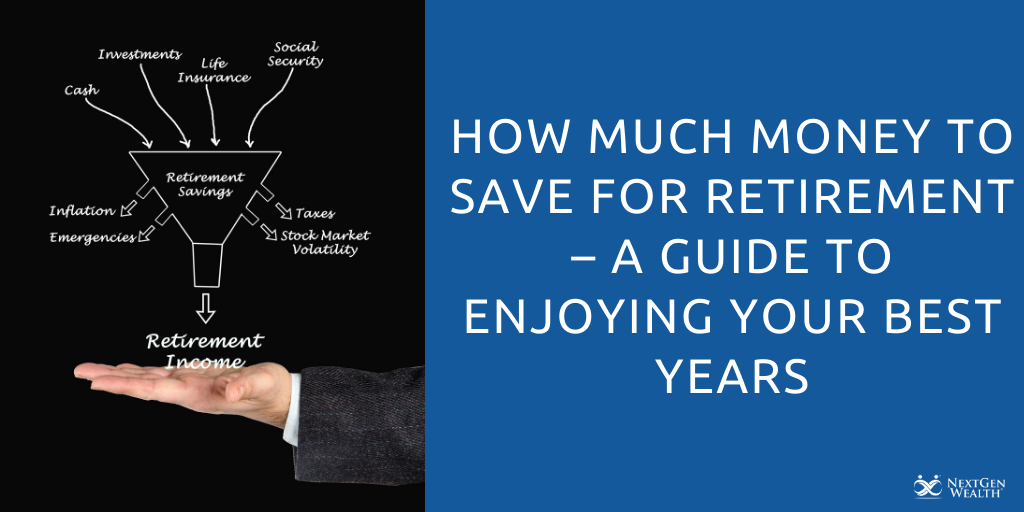
Today, on the other hand, it's a totally different story. It now basically falls completely on your shoulders. There are so many questions. How much should I save in my 401k? What do I even invest in? What about a Roth IRA? The list can go on and on. Let's take it step-by-step to get you moving in the right direction so you can get to retirement – or what I like to call financial independence – sooner rather than later.

When I got into this industry over 16 years ago, I’ll be honest and admit I really didn’t have a clue what I was doing. I started the Monday after I graduated from college and was thrown into the “bullpen” and told to start studying for my exams that I was to take over the next 4 months—I won’t bore you with the details.
Once I passed those, I then went through some really terrible sales training. When I returned back to the office, I was basically told to start bringing in new clients and good luck. Seriously, that was it.

Ever thought somebody owed you something, but you just can’t remember what? Well, guess what, maybe someone does, and it might just be waiting for you in a state where you once lived. And, it’s actually not out of the ordinary to find your name on a state's unclaimed property list.
Believe it or not, states are holding onto BILLIONS of dollars in unclaimed property. And, because of unclaimed property laws, this money has to be returned to you if you ever come looking for it. In 2015 alone, over $3 billion was returned! Crazier than that, though, almost $8 billion was collected leaving another $5 billion uncollected. Trust me, there is a lot of it out there.

When it comes to investing, the hype seems to be around the next hot investment and the incredible returns it will surely produce. While that is all good and well (not really), no one ever seems to talk about what not to do when it comes to a good investment strategy.
I truly believe, if you can avoid making dumb decisions, then that will ensure you’re making the right decisions. Investing isn’t about finding the next Apple; it’s about not making those common mistakes so many people can’t seem to avoid.

Being a financial advisor for the past 16 years, I know what lies behind the curtain in our industry. And, while things are slowly becoming more transparent, we still have a long way to go before reaching complete transparency.
As a consumer, though, you only know what you’re being told or at least how much you can find from doing your research on Google. The information is out there, but only so many people have the time to find out the right questions to ask.
