7 Goals to Accomplish When You Retire

This post was last updated on February 17, 2026, to reflect all updated information and best serve your needs.
You’ve reached many milestones in your life so far, but retirement brings new challenges and opportunities. You may already have many goals in mind, or you may be going back to the drawing board.
Remember, retiring isn’t the end of the road; it’s the beginning of a whole new chapter. Here are some worthwhile goals to consider as you enter your next phase of life.
Pre-Retirement Goals
As you approach retirement, it’s critical that you get the finishing touches right. Retirement looks different for everyone, but with over a decade of helping retirees navigate the transition, we can tell who’s the best prepared.
Increase Your Retirement Contributions
As you reach your final working years, you have a great opportunity to “top off” your retirement accounts. Individuals over 50 can make catch-up contributions to their qualified retirement accounts. This can be a great way to get the last little bit needed to fund your retirement goals.
For 2026, catch-up contributions are an additional $8,000 per year (in addition to the $24,500 limit) for qualified defined contribution plans, such as 401(k) or 403(b) plans. If you're age 60-63, you can contribute up to an additional $11,250. This is also the same limit for the federal Thrift Savings Plan.
For Individual Retirement Accounts (IRAs), the catch-up contribution is $1,100 in addition to the $7,500 limit for Roth and traditional IRAs. This means you could add an extra $39,000 per year through your 401(k) and IRA contributions alone. If your employer matches a portion of your contributions, you can really beef up your savings.
Calculate Your Earnings and Expenses
It may be challenging to figure out a retirement budget initially. Realistically, you’ll have to start calculating these figures as you get closer. You’ll have a much better idea of what your life looks like and the size of your nest egg.
Expenses
You want to make a comprehensive list of expenses before and during retirement. There may be things you miss, but we can get pretty close. A good baseline is to start tracking your expenses now and then review which expenses will stay the same, increase, decrease, or stop in retirement.
Here are some items to consider:
- Mortgage and Utilities - ideally, you’ll pay off your home mortgage at some point during retirement (if not before). If you rent, be sure to consider annual increases, as rents will continue to rise.
- Average Living Expenses - have an idea of what you spend on things like groceries, gas, and other items. When you retire, you might pay less for gas (no commute) or more if you start traveling frequently.
- Medical Expenses - as we get older, our bodies require more care. If your health insurance is tied to work, you need to have a plan for retirement. Consider premium payments, copayments, and any other out-of-pocket expenses. Remember, Medicare isn't automatic; you have to enroll.
- Assisted Living - long-term care costs can eat into your nest egg quickly. Start looking at the average price for care in your area so you have an idea of what to expect.
- Life Insurance – you’ll want to revisit life insurance needs in or near retirement. If you already have coverage, you may want to adjust, add, or drop coverage. Consider which expenses should be covered if you pass prematurely. You might also be able to switch policies through a 1035 exchange.
- Taxes – owning a home means property taxes, which will increase as your home appreciates. Check whether you qualify for special programs, such as a property tax freeze.
- Required Minimum Distributions – if you have money in traditional retirement accounts (401k, IRA, etc.), they'll be subject to Required Minimum Distributions (RMDs) at some point, which could raise your income taxes. Be sure to have a plan for this.
Retirement Income
Your income will need to cover your expenses. In retirement, you create your own stream(s) of income. The name of the game is to convert your retirement savings into “paychecks” to yourself to cover all your expenses without ever running out of money.
You’ll want to consider the following sources of retirement income:
- Pension Income – if you are fortunate enough to have a pension, start calculating what that pension will look like and take the final steps to maximize your benefits.
- Qualified Retirement Accounts – your 401(k), Thrift Savings Plan (TSP), or other retirement account will now be converted into a stream of income. The type of retirement account matters too. You may need to start using tax strategies such as Roth Conversions to avoid taxes and RMDs.
- Passive Income – if you have an ownership stake in a business, receive royalties, or rental income, these should be factored in as well.
- Social Security – don’t forget to include Social Security in your calculations. You’ll want to start considering your Social Security strategy before it’s time to begin. You DO NOT want to make this decision on your first visit to the Social Security office.
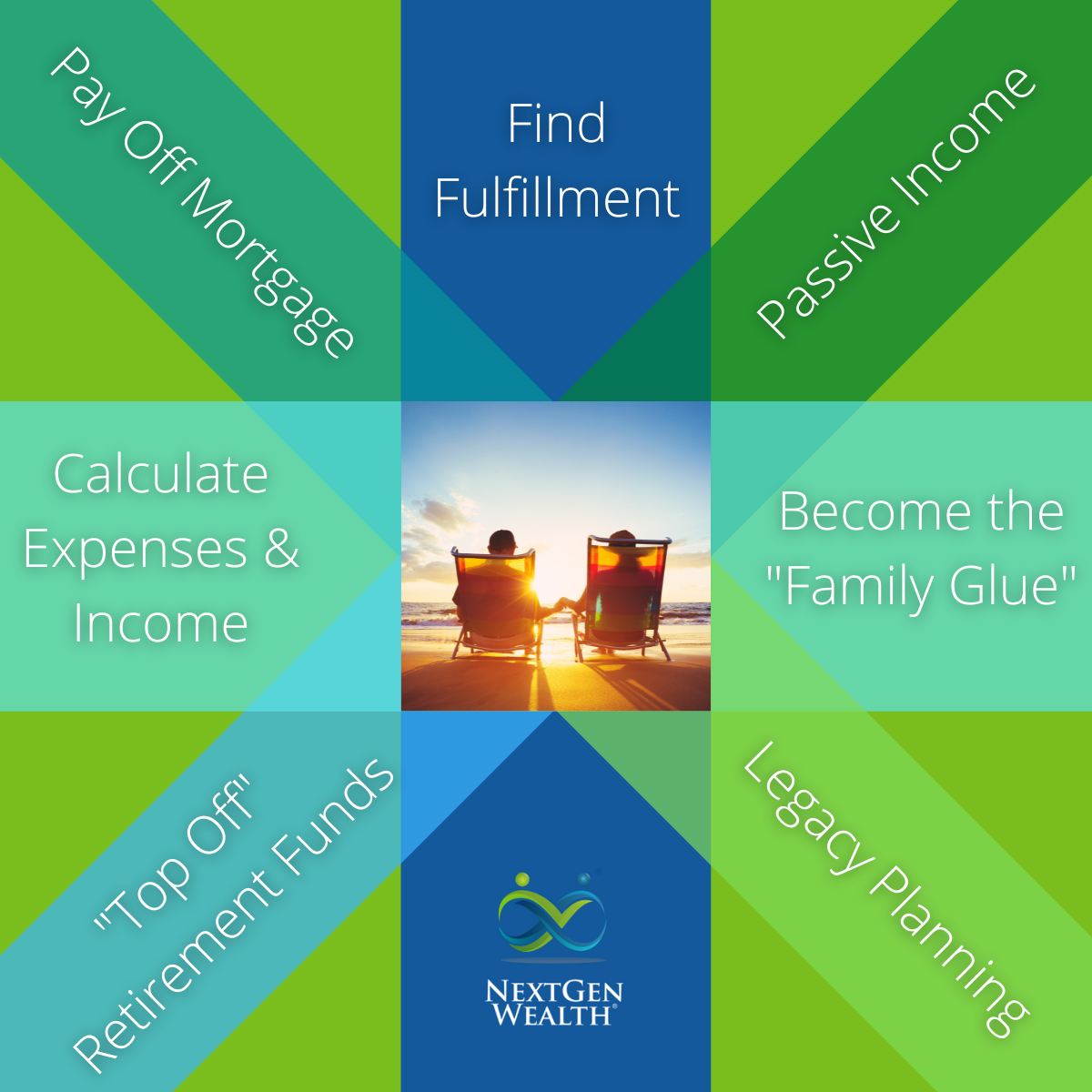
Retirement Goals
Once you retire, it’s time to celebrate! However, it’s even more important to define what you’re retiring to – not what you’re retiring from. Consider these goals to achieve during your golden years.
Pay Off the Mortgage
Paying off your primary residence is a very common and worthwhile goal for many retirees. In theory, if you bought your home on a 30-year mortgage in your 30’s, you might be pretty close to paying off the house regardless.
Paying off your house can give you greater peace of mind and greater stability in retirement. Also, this significantly reduces your expenses. You’ll still have property taxes to contend with (not true for all states), but that’s something we can’t avoid.
Consider Downsizing
During your working years, your home may have expanded. It's common for your income and family to grow over time. However, during retirement, a big house may be more than you bargained for.
The yard needs to be maintained, rooms cleaned, and taxes paid. If you don’t need much space during your later years, is it still worth it? If regular maintenance and upkeep are costly, you may consider downsizing to a smaller home to reduce monthly expenses.
However, you might want to leave the house for your children. Maybe you finally have time to put that kitchen remodel to use and entertain guests and family for annual holiday dinners. If your house still brings you value, then downsizing may not be right for you.
Finding Fulfillment
Now that you’re retiring, what are your goals for the next 20 to 30 years? For many people, now is the time to travel, but you’ll want to think about alternatives as well. Presumably, you won’t be jet-setting around the world 12 months a year.
Some options for getting more out of retirement than free time include:
- Volunteering – get active with local charities and donate your time and energy. Find a charity that shares your passion for an even greater reward.
- Complete Bucket List Items – now that you’re not working, it’s time to check off those feats you’ve always wanted to achieve. If you don’t have a bucket list, create one. Don’t forget the smaller items, too – not everything has to be life-changing.
- Teach a Class – having decades of experience means that you have plenty of knowledge to share. It’s never been easier to build an online curriculum, or you can teach at a local community center.
- Learn a New Skill – on the flip side of things, you can take this opportunity to learn something you’ve never tried before. Whether it’s juggling, playing an instrument, or something more substantial, it’s never too late to add to your resume.
- “Supercharge” Your Hobbies – whether you’re into woodworking, homebrewing, or art, now is a great time to really have fun. Maybe you even want to turn a hobby into a small side hustle?
Develop a Passive Income Stream
Even if you’re not worried about running out of money in retirement, having passive income is not a bad idea. You can put the funds toward a major trip or purchase (such as an RV), or you can save it for your kids. Here are a few ideas to generate extra income without punching the clock.
- Rent Out Space – if you have extra bedrooms in your home, consider renting them out. You’ll need to complete paperwork and possibly perform some light renovations, but you can get more than you might think. You can use platforms like Airbnb or Vrbo to rent a single room or the entire house.
- Invest in a Rental Property – if you don’t want to rent a room in your home, you may decide that investing in a separate rental property would be worthwhile. Granted, being a landlord involves its share of work. However, you could hire a property manager to handle this.
- Sell Crafts Online – if your retirement hobby is related to arts and crafts, you could earn income by selling on sites like Etsy.
Become the “Family Glue”
It might sound strange, but every family has one or two people who are the “glue” holding the family together. Many of us think back to family dinners, reunions, or vacations. Many families feel more and more distant, even though we’re more connected than ever before.
With some time, money, and effort invested in planning, you can bring some of these old traditions back to life. Now that you have a little more time on your hands, you can rekindle one-on-one relationships with family members you don’t get to see as often anymore.
No matter what, you’ll never regret trying to create more memories with the people you care about. Even if you don’t want to be the one organizing everything, maybe you can inspire someone else to take on that task.
Finalizing Your Legacy
One of the least fun, yet most important goals many retirees have is what they’ll leave behind. Estate planning is critical as you enter retirement. What are you going to leave behind for your children? What about your spouse?
Now is the time to start making moves regarding where your assets will be placed and how they will be distributed. Consider creating a trust to avoid probate, and be sure to talk to your loved ones so that they know what to expect.
Now is also the time to consider your end-of-life expenses. Discuss your wishes as well to avoid confusion or guilt. It may not be a pleasant topic, but it’s better to address it now than leave your loved ones wondering.
Why Your Goals Are Important to NextGen Wealth
Your goals are the most important aspects we use to help craft a financial plan with you. We use our COLLAB Financial Planning Process™ to help you define your goals and unlock what’s possible in retirement. The goals we discussed here are only suggestions based on what we’ve seen – your goals may be completely different.
Whether you’re 5 years from retirement or just retired yesterday, getting your goals and priorities in order is vitally important. We also don’t want you to skip a goal or dream because you don’t think you can afford it – that’s where our expertise comes in. Contact us today to receive your no-obligation financial assessment and start planning your retirement.

 This article was written by